


Lucca to Altopascio
My last post said that the next one would be to San Miniato, but I’m going to include Gambassi Terme in this one because I took almost no photos on the first stage from Lucca to Altopascio. The Via Francigena was virtually all asphalt for that first stage, and it ran through uninspiring suburban commercial and residential areas. Altopascio is quite a historic village, but you have to get off the main street to find its historic center.
What I did find interesting about Altopascio is that “here in the 1070s, Matilda of Tuscany, one of medieval Europe’s foremost female military and political leaders, founded the international Order of St. James of Altopascio or ‘Cavalieri del Tau’. This influential semi-military order spread its mission of hospitality and protection of pilgrims from here as far away as Portugal and Germany.” It’s interesting to me that women could be such powerful leaders in the 11th century, while the U.S. has yet to elect a female president. That is clearly the result of culture rather than capability.


The plaque on the right above says, “To the victims of the Nazi-Fascist reprisal to the fallen during the liberation of Altopascio 1944, September 4, 1974.” As they retreated, the Nazis engaged in a scorched earth campaign to terrify civilians and hinder the Allies. In Altopascio, roughly 30% of the buildings in the town and the surrounding hamlets were either destroyed or severely damaged.
Altopascio to San Miniato
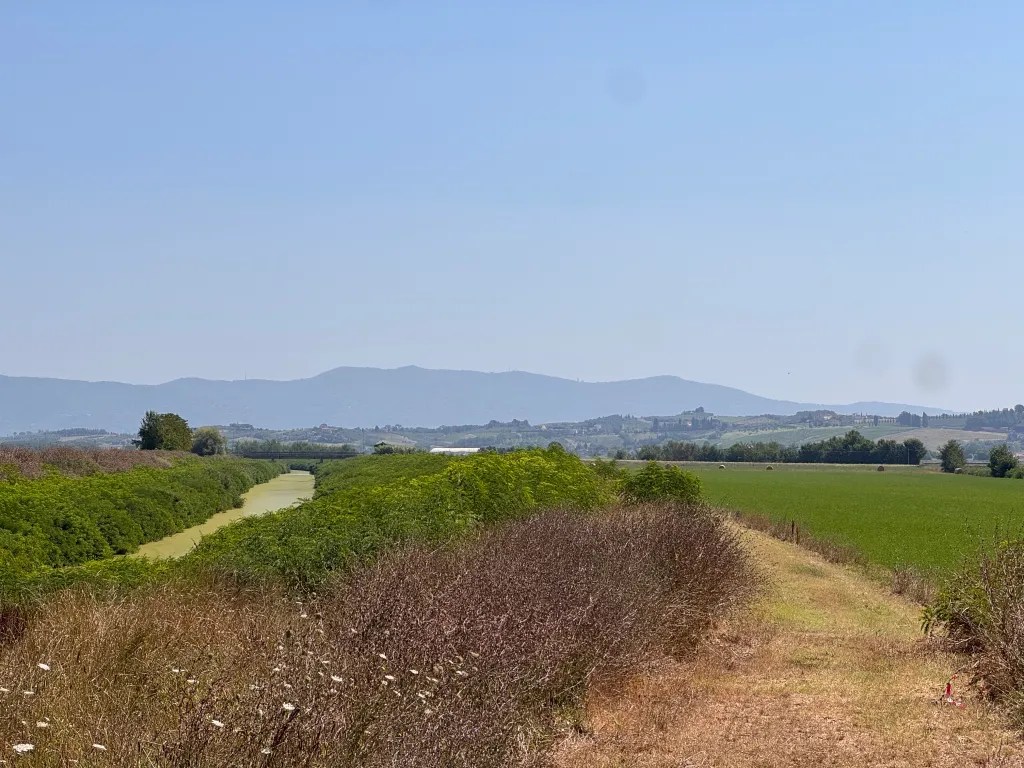
The walk from Altopascio to San Miniato was long, but it was considerably more interesting than the day before. The first third of the walk was through the woods. The second third was along canal dykes, and the last third was up the hill leading to San Miniato.


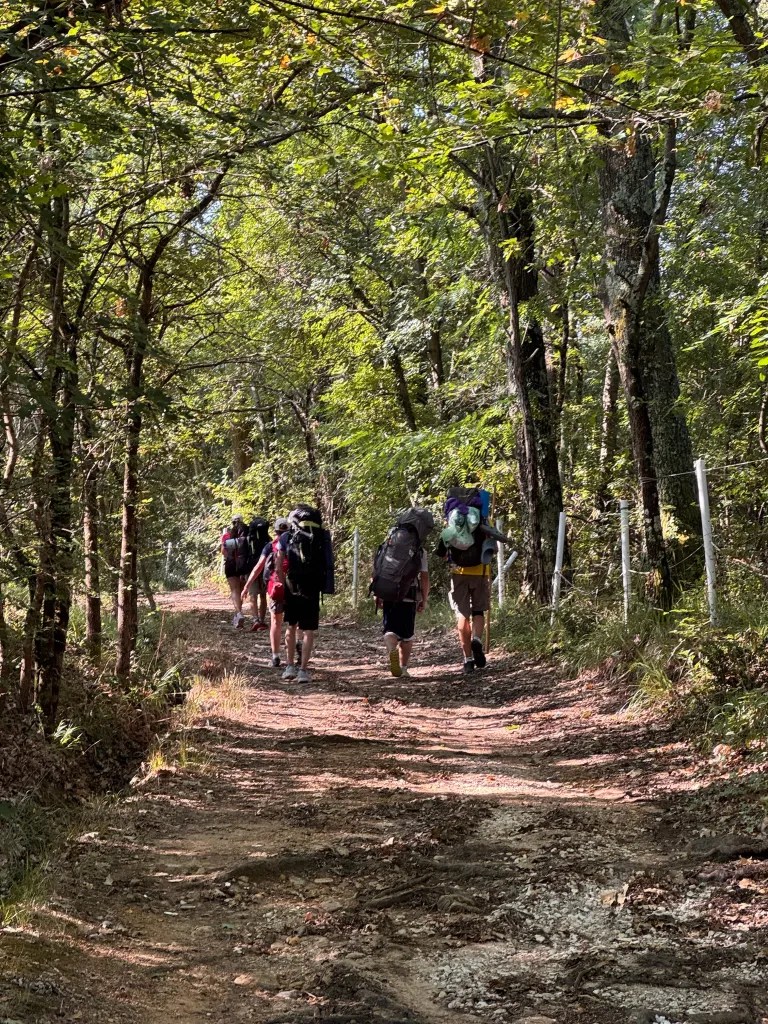



Seven or eight kilometers before San Miniato, I met Sebastian, a young Italian pilgrim who had started in Lucca to celebrate his recent graduation from the University of Bologna. He studied automation engineering, and his parents encouraged him to take a pilgrimage before he started on his career. He’s walking in advance of starting his career. I’m walking to celebrate the end of mine.

San Miniato
San Miniato occupies a commanding hilltop position at the intersection of the ancient Lucca-Siena and Florence-Pisa roads, which accounts for why the Lombards built a fortress there in the 8th century.


San Miniato to Gambassi Terme
The rolling hills from San Miniato to Gambassi are classic Tuscan countryside with open hay fields, rows of Italian Cypress trees, vineyards, and olive groves. The cypress trees, by the way, were brought to Italy by the Etruscans and the Greeks.


Gambassi Terme

Once you climb to the hilltop on which Gambassi Terme is located, you are rewarded with aerial views of the Tuscan countryside, but the views of daily life in Gambassi Terme were more interesting to me . A waitress told me that the group of men gather every day in the plaza to play Briscola, a popular Italian card game, for hours.


After dinner, I was walking through the back streets and saw this sign.


It was only a couple of tables and chairs in front of a house, so I gave it a try. The proprietor was Ansul, a Russian native, but he has lived in Gambassi Terme for 50 years. He only spoke a few words of English and a little bit of Spanish, but we managed to talk for 30 minutes while I finished my glass of Byson wine (made locally) for 2 Euros – including a pack of crackers. He then insisted on giving me another glass of wine to drink while he ate his dinner.


He also had a great dog.


Next up: San Gimignano, a UNESCO World Heritage Site
Discover more from Wanderings With Charles
Subscribe to get the latest posts sent to your email.
2 Responses
Matilda was quite a leader & politician. She and Queen Elizabeth may have been much alike. I read a little about the Lombards. They were a tribe from Germany that spread all through north Italy, filling a void left by Romans & Byzantines. Never knew that history. Komrad Ansul hit a home run when he moved to Italy. His story would be interesting. Sebastian will have a bright future with his degree. Fine pictures of the cobblestone trail, the towns and country and the people. Ann & I are still addicted to these reports. Keep us on the list next time you hit the trail.
I picked up a brief book yesterday in San Gimignano on Tuscan history, and I was blown away by the various aspects of the region’s history. It would be easy to spend a lifetime on it. I also spent some time in an archeology museum this afternoon in Colle di Val d’Elsa, and much of the museum was devoted to the Etruscans, who predated the Romans. The Etruscans didn’t leave as many monuments as the Romans, but they were a highly organized and talented group of people.
Yes, I wish I had been able to speak Italian because Ansul did have some stories to tell, I’m sure.